
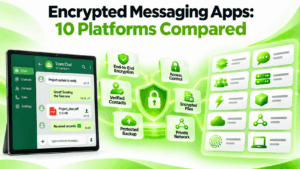
 An encrypted messaging app protects conversations by converting messages into unreadable data that unauthorized parties cannot easily access.
The strongest privacy-focused messengers use end-to-end encryption (E2EE), which ensures that only authorized participants and their devices can decrypt protected content. However, not every application described as secure or encrypted uses E2EE for ordinary messages. Some protect communication between devices and servers, while others focus on privately managed infrastructure, identity management, and enterprise security controls.
The best encrypted messaging app depends on the communication scenario. Signal is a strong choice for private everyday conversations, WhatsApp provides familiar encrypted messaging for a broad audience, and Threema emphasizes privacy without mandatory phone numbers. Element, Wire, SimpleX Chat, and Olvid offer different approaches to encrypted collaboration and identity protection. For organizations that need centrally managed communication infrastructure, TrueConf Server addresses a separate set of enterprise security requirements.
The most important distinction is whether encryption prevents the messaging provider from reading message content. End-to-end encryption, server ownership, secure backups, device verification, and regulatory compliance are different capabilities. Choosing the right platform requires understanding which protections are enabled by default, where messages are decrypted, and who controls the communication environment.
Encrypted Messaging Apps at a Glance
|
Platform |
E2EE by default |
Main advantage |
Best for |
|---|---|---|---|
|
Signal |
Yes |
Private messaging and contact verification |
Individuals and small teams |
|
|
Yes, for personal chats |
Familiar messaging and broad adoption |
Everyday communication |
|
Threema |
Yes |
Privacy without mandatory phone numbers |
Privacy-conscious users and organizations |
|
Element |
Depends on room configuration |
Federation and independent server operation |
Organizations requiring data sovereignty |
|
SimpleX Chat |
Yes, for private chats and groups |
No persistent global user identifier |
Users concerned about metadata |
|
TrueConf Server |
No documented E2EE for all ordinary chats |
Private infrastructure and corporate administration |
Enterprises and restricted networks |
|
Wire |
Yes |
MLS-based group encryption |
Organizations needing confidential team collaboration |
|
Telegram |
No, only Secret Chats use E2EE |
Cloud synchronization and large communities |
Users prioritizing flexible cloud messaging |
|
Conferendo |
E2EE for ordinary chats not verified |
Video communication with accompanying chat |
Personal video communication |
|
Olvid |
Yes |
Cryptographic identity verification |
Confidential professional communication |
Which Type of Encrypted Messenger Should You Choose?
For personal communication, start with applications that use E2EE automatically. Signal, Threema, Wire, and Olvid are relevant choices, while SimpleX Chat is particularly interesting when minimizing identity and relationship metadata matters. Users who want familiar communication with existing contacts may prefer WhatsApp, which provides E2EE for personal conversations by default.
For business communication, encryption is only one consideration. Organizations may also require corporate accounts, device management, retention policies, external collaboration, and integration with existing security infrastructure. Element, Wire, Threema Work, and TrueConf Server address different combinations of these requirements.
For private infrastructure, evaluate products with self-hosted or on-premises deployment. Element Server Suite, Threema OnPrem, and TrueConf Server offer relevant deployment options, but they do not all use the same message encryption model. Telegram and Conferendo also illustrate why the term encrypted messaging should not be treated as a guarantee that all conversations are end-to-end encrypted.
What Is an Encrypted Messaging App?
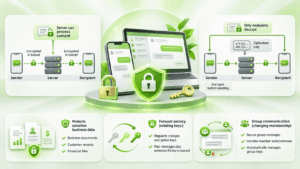
An encrypted messaging app is software that uses cryptography to protect messages and other communication data against unauthorized access.
Encryption converts readable information, called plaintext, into ciphertext. The original information can be recovered only by a system or participant possessing the appropriate cryptographic keys.
The protection depends on where encryption and decryption occur, how keys are managed, and which systems are authorized to access them. A messaging provider may encrypt traffic while retaining the technical ability to process messages on its servers. Another service may use E2EE, allowing only authorized endpoints to decrypt the protected conversation.
This difference matters when people exchange financial documents, personal information, customer records, confidential business discussions, or sensitive operational instructions.
How Does Encrypted Messaging Work?
When someone sends a message through an encrypted messaging application, the software uses cryptographic keys to protect its content. In a conventional client-server encryption model, the application may establish an encrypted connection with the provider’s infrastructure. The server can receive and process plaintext before forwarding the message through another encrypted connection.
With E2EE, content is encrypted on the sender’s device and decrypted on the authorized recipient’s device. Intermediate servers deliver ciphertext without possessing the ordinary keys needed to read it.
Modern protocols can provide forward secrecy and mechanisms that update encryption keys over time. These properties help limit the exposure of previous or future messages following certain cryptographic compromises. Group communication introduces additional complexity because encryption keys and membership must be managed as people join, leave, or change devices. The efficiency and reliability of these processes become particularly important for large organizations.
End-to-End Encryption vs. Transport Encryption vs. Encryption at Rest
The term encrypted messaging covers several different types of protection.
|
Encryption type |
What it protects? |
Who may decrypt the content? |
Main limitation |
|---|---|---|---|
|
End-to-end encryption |
Content exchanged between authorized endpoints |
Intended participants and their authorized devices |
Cannot protect plaintext on a compromised endpoint |
|
Transport encryption |
Data traveling between connected systems |
Endpoints of each encrypted connection, potentially including the provider’s server |
Servers may process readable content |
|
Encryption at rest |
Data stored on devices or servers |
Systems or users holding the storage encryption keys |
Does not necessarily protect data during processing |
|
Full-disk encryption |
Information stored on an encrypted device or volume |
Authorized systems after the volume is unlocked |
Applications may access plaintext while the device is operating |
|
VPN encryption |
Traffic crossing a protected network tunnel |
VPN endpoints and systems beyond the tunnel according to their own security models |
Does not independently provide E2EE |
Transport encryption helps protect traffic against interception. Storage encryption reduces exposure when stored information is accessed without the required keys. Both are valuable security controls, but neither guarantees that a messaging provider cannot read message content.
For users who want the provider to be technically unable to access ordinary private conversations, E2EE is the relevant requirement.
Businesses may have additional obligations involving retention, audit records, data loss prevention, and controlled network operation. Those requirements must be evaluated alongside the encryption model rather than assumed to be part of it.
Why Are Encrypted Messaging Apps Important?
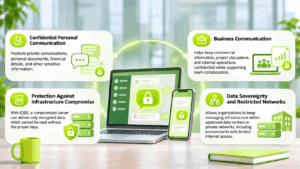
Messaging applications carry information that organizations once exchanged through formal document systems, telephone calls, or in-person meetings. Employees discuss contracts, financial records, customer projects, and internal operations, while individuals share personal documents, authentication information, and sensitive conversations with trusted contacts.
Encryption helps reduce exposure when communication passes through networks or infrastructure that users do not directly control. Its practical value depends on the information being protected and the parties from whom that information must remain confidential.
Confidential Personal Communication
Private conversations may contain medical information, family matters, financial details, or confidential documents. E2EE helps prevent intermediary infrastructure from reading supported message content during delivery.
Additional features such as disappearing messages, verified contacts, and protected backups can improve control over communication history. However, none of these features prevents an authorized recipient from copying information after opening it.
Business Communication
Businesses routinely share commercially sensitive information through messaging. An encrypted corporate messaging solution can help protect communication while supporting internal collaboration.
Larger organizations may also need company-owned accounts, employee directories, permissions, and controlled file exchange. These administrative requirements can make enterprise messaging platforms more suitable than consumer applications, even when a consumer app provides strong cryptographic confidentiality.
Protection Against Infrastructure Compromise
With properly implemented E2EE, compromising a delivery server does not automatically reveal the plaintext of protected conversations. An attacker may still obtain encrypted messages, available metadata, account information, or access to other connected services.
Encryption therefore reduces particular categories of exposure without eliminating the consequences of every possible attack.
Data Sovereignty and Restricted Networks
Some organizations need their communication infrastructure to remain within approved data centers or private networks. Self-hosted platforms can provide direct control over server location, access policies, and supporting services.
This is relevant to public institutions, regulated industries, research environments, and organizations operating networks with limited internet connectivity.
Encrypted Messaging Statistics: What the 2026 Security Research Shows?
Public cybersecurity studies illustrate why organizations need secure communication practices, although broader breach statistics do not directly measure the security of encrypted messaging applications.
According to the 2026 Verizon Data Breach Investigations Report, vulnerability exploitation accounted for 31% of breach entry points. Third-party involvement appeared in 48% of breaches, highlighting the importance of evaluating suppliers, infrastructure dependencies, and connected applications.
Verizon also reported that mobile-focused social engineering had a success rate 40% higher than traditional email phishing. This compares the effectiveness of the two attack methods rather than indicating a 40% annual increase.
Meanwhile, the IBM Cost of a Data Breach Report 2026 found that the global average cost of a data breach reached $4.99 million, up 12% from the previous year’s $4.44 million. IBM also reported a 56% increase in AI-driven attacks, reflecting the growing use of automated and AI-assisted techniques by attackers.
|
Security indicator |
Published finding |
Relevance to encrypted messaging |
|---|---|---|
|
Vulnerability exploitation |
31% of breach entry points in Verizon’s 2026 DBIR |
Messaging infrastructure and client software require timely updates |
|
Third-party involvement |
48% of breaches in Verizon’s report |
External communication providers and integrations introduce dependencies |
|
Mobile social engineering |
40% higher success rate than traditional email phishing |
Encryption cannot prevent users from being manipulated into sharing information |
|
Average organizational breach cost |
$4.99 million in IBM’s 2026 report |
Sensitive communication data should be included in enterprise risk assessments |
|
AI-driven attacks |
56% increase reported by IBM in 2026 |
Identity verification and protection against impersonation remain important |
These findings describe the broader cybersecurity environment. They do not establish that any particular encrypted messenger prevents a specific percentage of breaches.
Insight 1. An Encrypted Message Can Still Become a Data Breach: E2EE protects message content within a defined communication model, but that protection does not extend automatically to everything users do after decryption.
An employee may forward a confidential document to an unauthorized recipient, paste sensitive information into an unapproved AI tool, or leave an unlocked device unattended. Malware operating on an endpoint may also capture information after the messaging application decrypts it. Screenshots, downloaded attachments, and ordinary chat exports can create additional copies outside the application’s protected environment.
The practical security boundary of E2EE ends wherever authorized plaintext becomes available. Businesses therefore need endpoint security, access management, and information handling policies alongside encryption.
Best Encrypted Messaging Apps in 2026

The following ten platforms represent different approaches to encrypted messaging, privacy, and enterprise communication. Most provide E2EE functionality for supported private conversations, but their default protections and deployment models differ.
Not all encrypted messaging platforms offer the same protection. Telegram uses E2EE only for Secret Chats. TrueConf Server focuses on encrypted enterprise communication, infrastructure ownership, and administrative security controls rather than universal server-inaccessible message encryption. Conferendo provides video communication and text chat, but E2EE for its ordinary messages has not been independently established.
These distinctions matter because applications should be compared according to their cryptographic architecture rather than treated as interchangeable privacy solutions.
1. Signal
Best for: Individuals, professionals, and small teams seeking private messaging with E2EE enabled by default.
Signal focuses on confidential communication rather than advertising, business automation, or extensive enterprise administration. It provides direct and group messaging, attachments, disappearing messages, voice calls, and video calls. Users can access supported conversations through mobile and linked desktop applications without enabling a separate secret messaging mode.
End-to-End Encryption by Default
Signal uses E2EE for supported messaging and calling features, so ordinary conversations are protected automatically. Its cryptographic architecture includes forward secrecy and mechanisms that update encryption keys as conversations continue, helping limit exposure following certain compromises.
These protections reduce risks associated with message delivery and compromised key material, but they cannot prevent information from being stolen from an unlocked or infected endpoint.
Automatic Key Verification
In August 2026, Signal introduced automatic key verification as an additional mechanism for detecting unexpected changes to encryption keys. The feature uses key transparency and complements Signal’s existing safety number verification process.
Automatic verification has eligibility limitations. It requires relevant contact information in supported circumstances, while contacts connected exclusively through usernames may require manual verification. Cryptographic key verification also does not establish a person’s real-world identity.
Usernames and Phone Number Privacy
Signal allows users to initiate conversations through usernames without necessarily revealing their phone numbers to the other participant. A phone number is still required for account registration.
This reduces the need to disclose personal contact information during everyday messaging, although Signal is not a completely phone-free service.
Encrypted Backups and Multiple Devices
Signal provides optional encrypted backup mechanisms. Its September 2026 improvements expanded supported backup options across mobile and desktop environments.
Backup protection depends on the chosen method, recovery credentials, application version, and devices involved. Users should verify their settings rather than assume that every linked device and conversation is automatically covered.
Group Communication
Signal supports private groups with participant management, file exchange, and encrypted group calling. These capabilities are useful for small teams handling confidential discussions without operating their own communication servers.
However, Signal does not provide the same centralized organizational provisioning, retention controls, or independently operated server options as dedicated enterprise messaging platforms.
Business benefit: Signal provides strong default message confidentiality without requiring users to manage complex encryption settings.
Strengths: Default E2EE, safety numbers, key transparency, disappearing messages, encrypted calls, and protected backup options.
Limitations: Phone number registration remains necessary, and centralized enterprise governance is limited.
2. WhatsApp
Best for: Individuals and small businesses that need encrypted communication through a familiar, widely adopted application.
WhatsApp provides direct messages, group conversations, file sharing, and voice and video calls. Its major advantage is accessibility: customers, partners, and colleagues may already use the application, reducing the effort needed to establish communication.
Default E2EE for Personal Messages
WhatsApp uses E2EE for supported personal chats and calls. Users do not need to activate a separate encryption mode for ordinary personal conversations, and the technology incorporates cryptographic mechanisms associated with the Signal Protocol.
Businesses should nevertheless distinguish personal communication from workflows involving external customer service platforms, CRM systems, or automation providers. Those integrations may introduce additional systems that process message content.
Encrypted Backups
WhatsApp supports optional end-to-end encrypted backups. Users can protect backup access through supported mechanisms including passwords, recovery keys, and passkeys.
These settings matter because archived conversation history may otherwise have different security properties from messages exchanged during live communication.
WhatsApp Business
WhatsApp Business adds customer communication features, business profiles, and supported automation. A small retailer can use it to answer inquiries, coordinate appointments, and provide service updates without requiring customers to install unfamiliar software.
The convenience of these workflows introduces an additional consideration: organizations must evaluate how external systems and connected providers process business conversations.
Group Communication
WhatsApp supports group messaging, documents, voice messages, and group calls, making it convenient for small teams and external communication.
Larger organizations may encounter limitations around employee account ownership, centrally managed permissions, retention, and separation between personal and business conversations.
Business benefit: WhatsApp provides familiar encrypted communication with relatively little adoption friction.
Strengths: Default E2EE for personal chats, broad availability, group communication, calls, and encrypted backup options.
Limitations: Phone number-based accounts, reliance on provider infrastructure, and additional data handling considerations for business integrations.
3. Threema
Best for: Privacy-conscious individuals and businesses that want E2EE without mandatory phone number registration.
Threema is built around confidential communication and data minimization. Its product family includes personal messaging, Threema Work for organizational communication, and Threema OnPrem for companies that require private infrastructure.
Messaging Without Mandatory Phone Numbers
Threema does not require a phone number or email address to create an account. Instead, users communicate through a Threema ID, allowing employees and external contacts to exchange messages without revealing their personal telephone numbers.
Contact synchronization remains optional, so users can decide whether to connect the application to their existing address books.
End-to-End Encryption and Contact Verification
Threema provides E2EE for supported direct messages, group conversations, attachments, voice calls, and video calls. Its client applications are open source, allowing independent inspection of relevant implementation details.
The platform also offers contact verification mechanisms, including QR code verification. These help users establish confidence that an account belongs to the intended communication partner, rather than relying entirely on an unverified display name.
Threema Work
Threema Work adds enterprise administration. Organizations can manage employee accounts, distribute applications, apply supported policies, and integrate selected administrative systems.
For example, a consulting company can provide encrypted employee communication without requiring workers to use personal phone numbers for business messaging.
Threema OnPrem
Threema OnPrem allows organizations to operate messaging infrastructure within their own environment. This is relevant to businesses with strict data residency or network control requirements.
Private deployment provides additional operational control, but it also introduces maintenance, update, and support responsibilities that the organization must plan for.
Business benefit: Threema combines encrypted communication, minimal identity requirements, and dedicated enterprise deployment options.
Strengths: No mandatory phone number, E2EE, contact verification, open-source clients, organizational administration, and on-premises deployment.
Limitations: Commercial licensing and a smaller consumer contact network than mainstream messaging services.
4. Element
Best for: Organizations requiring encrypted communication across independently managed infrastructure.
Element is a communication platform based on the Matrix open standard. Unlike traditional centralized messaging services, Matrix allows compatible servers to exchange information through federation.
This makes Element relevant to public institutions, enterprises, research organizations, and distributed professional communities that want interoperable communication without relying on one central service operator.
Encrypted Matrix Rooms
Element supports E2EE for compatible Matrix conversations. Authorized devices decrypt protected messages while homeservers handle delivery and other infrastructure functions.
However, encryption depends on room configuration, client capabilities, and integrations. Organizations must ensure that sensitive rooms use the expected encryption settings and that connected systems preserve the intended confidentiality model.
Federation
Matrix federation allows organizations to operate independent servers while participating in shared conversations. For example, two universities can maintain separate communication environments while enabling researchers to collaborate in selected encrypted rooms.
This provides interoperability without requiring every user account to belong to the same provider. Federation also introduces governance requirements involving server configuration, room membership, metadata, and retained events.
Element Server Suite
Element Server Suite provides backend infrastructure and enterprise options for organizations operating Matrix communication systems.
Available capabilities include deployment management, identity integration, security maintenance, and supported administration features. The product family also addresses restricted and privately managed environments.
Device Verification and Key Recovery
Element supports device verification and mechanisms for managing encrypted access across multiple devices. These features are important when employees replace laptops or phones while needing continuity of communication.
Organizations should establish procedures for device enrollment, recovery, and revocation, particularly when users participate in long-running encrypted project rooms.
Business benefit: Element combines encrypted collaboration with decentralized infrastructure and organizational control.
Strengths: Matrix interoperability, federation, E2EE, self-hosting, device verification, and enterprise deployment options.
Limitations: Federation, encryption recovery, and governance require careful configuration.
5. SimpleX Chat
Best for: Users who want encrypted communication with minimal persistent identifiers and reduced relationship metadata.
SimpleX Chat uses a messaging architecture that does not assign users persistent global network identifiers. Instead of relying on phone numbers, email addresses, or fixed public usernames, SimpleX establishes communication through invitations and separate connection identifiers.
This approach makes SimpleX distinctive among privacy-focused messengers because it addresses not only message content, but also how communication relationships are represented within the network.
No Persistent Global User ID
SimpleX allows users to create messaging profiles without providing a phone number or email address. Contacts connect through one-time invitation links or supported reusable contact addresses.
This makes it harder for messaging infrastructure to associate every conversation with a universal account identifier. Local profile names do not function as global network identities.
E2EE for Private Chats and Groups
SimpleX provides E2EE for direct conversations and supported group chats. Its security architecture includes mechanisms for forward secrecy and recovery following certain cryptographic compromises.
Group communication uses participant connections rather than relying on a conventional centralized directory of users.
Different Protection for Channels
SimpleX also provides channels for distributing content to larger audiences. However, public channel messages are not E2EE, and channel relays can access their content.
Private groups and public channels should therefore be treated as separate communication models, particularly when users intend to share confidential information.
Relay Architecture and Privacy
SimpleX uses relay servers to deliver messages while separating delivery queues from persistent user identities. Users can select compatible relays and operate their own relay infrastructure.
The platform also offers privacy-oriented options such as incognito profiles and supported anonymous network configurations.
Practical Limitations
SimpleX is particularly interesting for private conversations and smaller groups. Its connection architecture may introduce additional overhead in larger groups, and the platform does not provide the same centralized corporate administration as enterprise communication suites.
Business benefit: SimpleX offers encrypted messaging with an architecture designed to reduce identity correlation and persistent user tracking.
Strengths: No global user identifier, E2EE private chats, relay flexibility, incognito profiles, and privacy-focused routing.
Limitations: More complex contact discovery, limited enterprise management, and different encryption properties for channels.
6. TrueConf Server
Best for: Enterprises and public institutions requiring encrypted corporate messaging, video conferencing, and controlled infrastructure.
TrueConf Server is an on-premises communication platform combining messaging, group chats, channels, file exchange, and video collaboration.
Unlike consumer messengers built primarily around provider-inaccessible E2EE, TrueConf focuses on private deployment, encrypted communication channels, organizational administration, and integration with enterprise security systems.
Corporate Messaging and Channels
TrueConf Server supports direct messages, group chats, and channels for internal communication. Employees can exchange files, coordinate projects, and move from ongoing conversations into video meetings when a live discussion becomes necessary.
For example, an engineering department can maintain a project chat and launch a conference to resolve a technical issue without switching to a separate communication platform. This provides continuity between asynchronous messaging and real-time collaboration.
Encryption and Communication Security
TrueConf uses protections including TLS and AES-based encryption for supported communication components. These mechanisms protect communication according to the client, protocol, and deployment configuration.
End-to-end encryption for all ordinary chat messages is not established by the available product information. TrueConf’s enterprise architecture emphasizes encrypted client-server communication and infrastructure administered by the organization.
This distinction does not mean the platform lacks encryption. It means the documented protection model should not be presented as equivalent to E2EE systems in which intermediary servers cannot decrypt ordinary conversation content.
On-Premises and Isolated-Network Deployment
TrueConf Server can be installed on Windows or Linux infrastructure controlled by the organization. Its full licensed edition supports autonomous internal communication within suitable private or isolated networks without public internet access for ordinary operation.
This is relevant to industrial facilities, research institutions, government organizations, and companies with restricted connectivity. Licensing and deployment requirements should be verified before planning an offline environment.
Corporate Identity Integration
TrueConf Server supports Active Directory and LDAP, allowing organizations to connect employee accounts with existing directories and manage access through established corporate identities.
This reduces dependence on personal phone numbers and simplifies administration when employees join, change roles, or leave the company.
Video Conferencing and Collaboration
TrueConf integrates messaging with video calls, group conferences, presentations, screen sharing, and supported remote desktop control. Depending on licensing, conferences can accommodate up to 2,000 participants.
The platform also supports compatible SIP and H.323 devices, allowing organizations to connect existing professional conferencing equipment.
DLP Integration in TrueConf Enterprise
ICAP-based Data Loss Prevention integration is an enterprise security capability available in TrueConf Enterprise. It should not be assumed to be included in every TrueConf Server edition or license.
The functionality allows supported text messages and files exchanged in chats to be checked through a connected DLP system. For example, an organization may use established policies to identify prohibited transfers of confidential documents or sensitive information.
Administrators can configure message and file inspection through the supported ICAP integration settings, subject to licensing and the deployed security infrastructure. The capability is relevant to organizations that prioritize centralized information handling policies alongside protected communication channels.
Practical Application
A manufacturing company operates several facilities connected through an internal network. Employees use TrueConf for project coordination, operational messaging, technical support, and video meetings.
The IT department manages corporate accounts through its existing directory and maintains communication infrastructure within approved facilities. If the organization uses the appropriate TrueConf Enterprise edition, it can also evaluate ICAP-based DLP integration for supported messaging workflows.
This approach is relevant when communication security is closely connected to infrastructure control and organizational administration.
Business benefit: TrueConf Server combines encrypted corporate communication, privately managed infrastructure, and integrated workplace collaboration.
Strengths: On-premises deployment, corporate chats, video conferencing, directory integration, transport and media encryption, isolated-network operation, and enterprise DLP integration options.
Limitations: End-to-end encryption for all ordinary chat messages is not established. ICAP-based DLP requires the relevant enterprise capability and licensing.
7. Wire
Best for: Enterprises requiring E2EE collaboration, file exchange, and secure group communication.
Wire combines encrypted messaging, voice and video communication, file sharing, and organizational collaboration features. Its distinctive security capability is support for Messaging Layer Security, an IETF-standardized protocol designed for efficient group encryption.
Messaging Layer Security
MLS uses a tree-based key management approach. Instead of requiring every group update to be handled through a large collection of independent pairwise operations, MLS supports more efficient changes to group encryption state.
This is valuable when organizations manage large groups containing participants with multiple devices. Wire announced general availability of MLS support in April 2025.
Default E2EE
Wire provides E2EE for supported messages, calls, and shared files. Its encryption model is designed to protect ordinary conversation content against intermediary access.
The product also emphasizes transparent cryptographic implementation and external security review.
Enterprise Collaboration
Wire supports group conversations, conferencing, document exchange, and organizational communication.
For example, a legal team can coordinate a confidential matter across offices while managing participants and shared information within a dedicated collaborative environment. Enterprise customers can evaluate supported administration and user management features for their deployment.
Group Membership Security
Group security becomes especially important when employees join projects, change responsibilities, or leave an organization.
MLS provides mechanisms for updating cryptographic group state when membership changes. However, organizations still need account management and device revocation processes to ensure former participants cannot access newly protected communication.
Compliance Considerations
Wire’s E2EE model may require specific approaches to authorized retention, investigation, and records management. Companies should review the available enterprise capabilities rather than assume that server-side plaintext inspection is possible.
Business benefit: Wire combines encrypted collaboration with group security mechanisms designed for changing organizational teams.
Strengths: MLS, default E2EE, encrypted calls, file sharing, enterprise collaboration, and group security.
Limitations: Commercial licensing and the need to align E2EE with organizational retention and compliance requirements.
8. Telegram
Best for: Users prioritizing cloud synchronization, large communities, and flexible messaging while understanding that E2EE is not the default.
Telegram supports personal messages, groups, channels, file sharing, calls, and bots. Its security model differs from E2EE-first messengers because ordinary cloud conversations and Secret Chats have different protection levels.
Cloud Chats
Telegram’s standard Cloud Chats use encryption between clients and its server infrastructure. This architecture allows message history to synchronize across supported devices.
However, ordinary Cloud Chats are not E2EE. Users should not assume that standard Telegram messages offer the same provider-inaccessible confidentiality as Signal or Threema.
Secret Chats
Telegram offers Secret Chats for supported one-to-one conversations requiring E2EE. These conversations are associated with participating devices rather than the ordinary cloud synchronization environment.
Secret Chats also provide additional controls, including restrictions on forwarding. Users must select this mode when its confidentiality properties are required.
Large Groups and Channels
Telegram is suitable for large communities and information distribution. Its channels and groups help organizations publish updates, coordinate audiences, and maintain public or semi-public discussions.
Standard groups and channels are not E2EE, so they are better understood as cloud communication features than private encrypted group messaging.
Bots and Integrations
Telegram supports bots that automate notifications, process requests, and connect conversations with other services. Messages handled by bots may be accessible to the bot operator or connected infrastructure.
Businesses should avoid treating bot conversations as automatically confidential simply because the underlying application uses encryption.
Business benefit: Telegram provides flexible cloud messaging and community features, with optional E2EE for individual Secret Chats.
Strengths: Cloud synchronization, large groups, channels, bots, file exchange, and Secret Chats.
Limitations: Ordinary Cloud Chats and standard groups are not E2EE.
9. Conferendo
Best for: Individuals seeking video communication with accompanying chat, rather than an independently verified E2EE messenger.
Conferendo focuses on personal video calls, small group conferences, and broadcast-style communication. Its text messaging functionality complements video conversations, but E2EE for ordinary chat messages has not been independently verified.
Video Calls and Conferences
Conferendo supports personal video calls and interactive group conferences. Its free 3×3 format accommodates up to three interactive participants, while premium 6×6 conferences support up to six. Broadcast modes allow a limited number of speakers to communicate with larger audiences.
These features make the service more relevant to video-based communication than to confidential text messaging as a primary use case.
Text Chat and Local History
Conferendo includes text chat and optional locally stored conversation history. Users can review previous exchanges and clear stored history when necessary.
These capabilities support communication continuity, but they do not establish whether chat messages are end-to-end encrypted during transmission.
Infrastructure and Encryption
Conferendo relies on provider-managed communication infrastructure rather than a confirmed independently deployable server edition.
Its available security information is insufficient to establish E2EE for ordinary messages. This does not prove that Conferendo lacks encryption, but users requiring verified provider-inaccessible message content should evaluate services with established E2EE models.
Business benefit: Conferendo combines video conferencing and accompanying text communication.
Strengths: Personal video calls, small group conferencing, broadcast modes, and local chat history.
Limitations: E2EE for ordinary chats is not verified, enterprise administration is limited, and independent server deployment is not confirmed.
10. Olvid
Best for: Professionals and organizations that prioritize confidential communication and cryptographic identity verification.
Olvid focuses on encrypted messaging and secure identity management. Its approach emphasizes establishing trusted communication relationships through cryptographic mechanisms rather than depending entirely on phone numbers or conventional centralized identity directories.
Cryptographic Identity Verification
Olvid allows users to establish verified contacts through supported identity exchange procedures. This helps users determine whether the cryptographic identity associated with a conversation belongs to the intended participant.
For legal, financial, or sensitive professional communication, correctly identifying the recipient can be as important as encrypting the message itself.
End-to-End Encryption
Olvid provides E2EE for supported messaging, group communication, attachments, and calls. Its design aims to prevent intermediary infrastructure from accessing ordinary protected message content.
The platform therefore addresses both confidentiality and trusted communication identities.
No Mandatory Phone Number
Olvid does not require a phone number to create a messaging identity. Professionals can separate secure communication from personal telephone details without relying on phone-number-based contact discovery.
This can be particularly useful when people need to establish confidential relationships with clients or external collaborators.
Multi-Device Communication
Olvid supports mobile and desktop applications with selected multi-device functionality.
Organizations should evaluate device enrollment, identity recovery, and account removal when planning deployment. These procedures influence both usability and the security of long-term communication history.
Professional Use
Olvid offers capabilities relevant to professional communication. A legal practice or consulting company may use it for confidential exchanges with verified contacts.
Businesses should assess the available enterprise administration, support, and records management options for their selected offering.
Business benefit: Olvid combines E2EE with cryptographic identity verification and minimal personal identifier requirements.
Strengths: E2EE, identity verification, no mandatory phone number, secure groups, and professional communication options.
Limitations: Identity verification and recovery require appropriate procedures, and organizational capabilities depend on the selected offering.
Encrypted Messaging Apps Compared by Security Model
The most important difference between encrypted messaging applications is not simply whether they use cryptography, but where decryption happens and who can access protected content.
|
Platform |
E2EE for ordinary private messaging |
Phone number required |
Self-hosting or private deployment |
Main security consideration |
|---|---|---|---|---|
|
Signal |
Yes |
Yes, for registration |
No general customer-hosted server edition |
Default E2EE, limited enterprise governance |
|
|
Yes, for personal chats |
Yes |
No standard customer-hosted consumer deployment |
Business integrations and backups need separate review |
|
Threema |
Yes |
No |
Threema OnPrem |
Commercial licensing and edition selection |
|
Element |
Yes, in encrypted rooms |
No |
Yes |
Federation, room settings, and key recovery |
|
SimpleX Chat |
Yes for direct chats and private groups |
No |
Self-operated relay options |
Public channels have a different security model |
|
TrueConf Server |
No documented E2EE for all ordinary chats |
No personal phone number required for corporate accounts |
Yes |
Encrypted client-server communication and administration |
|
Wire |
Yes |
Depends on account setup |
Verify current enterprise offering |
MLS and enterprise group security |
|
Telegram |
Only in Secret Chats |
Yes, for registration |
No standard self-hosted Telegram cloud |
Ordinary Cloud Chats are not E2EE |
|
Conferendo |
E2EE for ordinary chats not verified |
Account required |
No confirmed self-hosted edition |
Encryption model requires additional evidence |
|
Olvid |
Yes |
No |
Verify product-specific deployment options |
Cryptographic identity management |
Specific capabilities and deployment arrangements can change. The table describes the platforms’ security models rather than assigning an absolute security ranking.
Insight 2. Server Ownership and End-to-End Encryption Are Different Security Decisions: An organization can operate its own communication server while allowing that server to process readable messages. Another organization may use an external provider whose E2EE architecture prevents the server from decrypting ordinary conversations.
These approaches protect against different risks. Self-hosting provides control over infrastructure, data location, network access, and administrative policy. E2EE reduces intermediary access to content but may complicate centralized inspection and records management.
Before selecting a platform, organizations should decide who must be technically unable to read messages and who must be authorized to inspect them. That distinction is more useful than treating encryption and private deployment as interchangeable security features.
What Makes an Encrypted Messaging App Secure?

Strong messaging security depends on the complete application environment. The quality of the encryption protocol matters, but so do identity verification, device protection, key recovery, backup handling, and software maintenance.
Encryption by Default
Automatic E2EE reduces the possibility that users unintentionally exchange sensitive information through a conversation mode with different protection. Telegram illustrates why defaults matter: Secret Chats provide E2EE, while standard Cloud Chats do not.
Organizations should verify which specific features receive protection rather than relying on broad product descriptions.
Recipient Verification
Encryption protects content for the holders of the appropriate keys, but it does not automatically prove who controls those keys.
Signal’s safety numbers, Threema’s verification mechanisms, and Olvid’s identity management tools address this issue in different ways. For sensitive communication, businesses should establish procedures for verifying external participants and investigating unexpected identity or key changes.
Metadata Protection
Messaging metadata may include account identifiers, device information, IP addresses, communication times, and relationships between participants. E2EE does not necessarily protect all of this information.
SimpleX attempts to reduce persistent identifiers through its architecture, while other applications use centralized account models. Users should review what a provider collects and retains rather than assume encrypted content makes every communication activity invisible.
Device Security
A compromised device may expose messages after the application decrypts them. Operating-system updates, screen locks, application security, and device management therefore remain essential.
Businesses should also maintain procedures for lost devices, employee departures, and unauthorized account access.
Secure Backups
Live messages and archived conversation history can have different security properties. A service may use E2EE for message delivery while relying on a separate cloud backup mechanism.
Users should verify whether backups are encrypted, how recovery keys are protected, and what information remains accessible after an account or device is lost.
Transparent Security Architecture
Open-source implementations, published cryptographic protocols, and independent assessments can make security claims easier to evaluate.
However, code availability alone does not guarantee secure operation. The deployed version, configuration, dependencies, and maintenance process all influence actual protection.
How to Choose an Encrypted Messaging App for Business?
Business messaging requires more than protecting individual conversations. Organizations need to manage employees, devices, external contacts, data retention, and access to corporate information.
A suitable communication platform should support these requirements without creating inaccurate expectations about who can read message content.
Enterprise Messaging Security Checklist
|
Requirement |
Why it matters? |
What to verify? |
|---|---|---|
|
E2EE |
Limits intermediary access to content |
Which messages, calls, files, and groups are protected |
|
Identity verification |
Reduces impersonation risk |
Safety numbers, verified contacts, or comparable controls |
|
Centralized administration |
Supports employee onboarding and departures |
SSO, directory integration, provisioning, and revocation |
|
Device management |
Controls organizational endpoints |
Enrollment, security policies, and device removal |
|
Data residency |
Determines where information is processed |
Servers, backups, telemetry, and support access |
|
Retention and legal discovery |
Supports organizational recordkeeping |
Authorized archives, exports, and retention settings |
|
DLP and monitoring |
Helps enforce information handling policies |
Whether inspection is compatible with the encryption architecture |
|
External collaboration |
Supports communication with partners |
Guest access, identity controls, and permissions |
|
Offline operation |
Supports restricted environments |
Internal services, licensing, and network dependencies |
|
Administrative auditing |
Supports governance and investigations |
Logs, roles, and authorized access |
Consumer Messengers vs. Enterprise Messaging Platforms
Consumer applications generally emphasize convenient accounts, contact discovery, and personal communication. Enterprise platforms may add employee directories, managed devices, administrative policies, retention options, and private deployment.
However, more administration does not automatically imply stronger content confidentiality. An E2EE-first messenger may prevent ordinary server-side inspection, while a corporate communication platform may deliberately allow certain authorized security controls to process content.
The correct choice depends on the organization’s threat model and operational obligations.
Cloud vs. Self-Hosted Messaging
Provider-hosted messaging reduces the need to maintain communication infrastructure. Self-hosted systems allow organizations to control server placement and selected data handling processes, but require their own operational resources.
A small professional practice may prefer an E2EE service when direct message confidentiality is its primary concern. A large organization operating restricted infrastructure may instead evaluate Element Server Suite, Threema OnPrem, or TrueConf Server, depending on its required combination of privacy, administration, and network autonomy.
Common Security Mistakes When Using Encrypted Messengers

A frequent mistake is assuming that all conversations within an application have identical encryption properties. Telegram’s Cloud Chats and Secret Chats differ, as do SimpleX private groups and public channels.
Another is overlooking recipient verification. A message can be encrypted correctly and still reach an impersonator if the sender accepts an unverified identity. Businesses may also neglect backups, linked devices, chat exports, and access after employee departures, each of which can create a separate route to sensitive information.
Finally, organizations sometimes introduce encrypted consumer messaging without reviewing retention requirements or corporate account ownership. These problems should be addressed through documented policies and technical controls rather than relying entirely on the application.
Insight 3. Strong Privacy Can Conflict With Centralized Compliance: E2EE is designed to limit the systems that can decrypt protected content. Enterprise compliance may require authorized retention, searching, legal discovery, and information inspection.
These requirements can conflict when an organization expects servers to inspect plaintext while also claiming those servers cannot decrypt messages.
An E2EE-focused organization may need endpoint-based recordkeeping or other supported mechanisms for authorized access. A company prioritizing centralized DLP may instead select a controlled client-server communication architecture.
The appropriate security model must account for both confidentiality and legitimate organizational obligations. Encryption alone does not establish regulatory compliance.
Are Encrypted Messaging Apps Completely Private?
No messaging application guarantees complete privacy in every circumstance.
Even with E2EE, information may be exposed through compromised devices, unsafe backups, message forwarding, screenshots, malicious recipients, or account recovery abuse. Providers may also process limited account and operational metadata according to their architecture and privacy practices.
The more useful question is which information an app protects, from whom, and under what circumstances.
Insight 4. Different Threats Require Different Messaging Architectures: A journalist protecting confidential sources may prioritize E2EE, verified contacts, and minimal identity disclosure. Signal, Threema, SimpleX, and Olvid offer different capabilities relevant to this scenario.
An organization concerned about compromise of a third-party communication provider may prioritize provider-inaccessible E2EE and strong device management. Wire or appropriately configured encrypted Element rooms can address aspects of that threat.
A manufacturing company operating an isolated network may prioritize private deployment, internal identities, and autonomous communication. TrueConf Server or another verified private solution may be more relevant, even though its encryption architecture differs from E2EE-first messengers.
A regulated financial institution may also require authorized archives and documented investigations, changing how encryption and organizational administration must work together.
The strongest communication platform is the one whose technical protections match the actual threat. A long list of security features cannot compensate for an unsuitable trust model.
Which Encrypted Messaging App Should You Choose?
|
User or organization |
Platform to evaluate |
Main reason |
Key limitation |
|---|---|---|---|
|
Individual seeking private conversations |
Signal |
Default E2EE and contact verification |
Phone number registration |
|
Small business communicating with customers |
|
Familiar encrypted personal communication |
Business integrations require separate review |
|
User avoiding personal contact identifiers |
Threema |
E2EE without mandatory phone numbers |
Commercial licensing |
|
Organization requiring decentralized communication |
Element |
Matrix federation and self-managed servers |
Encryption and federation administration |
|
User concerned about identity correlation |
SimpleX Chat |
No persistent global network identifier |
More complex contact discovery |
|
Enterprise needing private corporate communication |
TrueConf Server |
Messaging, video meetings, directory integration, and infrastructure control |
No documented E2EE for all ordinary chats |
|
Organization prioritizing encrypted group collaboration |
Wire |
MLS and E2EE for supported collaboration |
Compliance and enterprise licensing considerations |
|
User managing large communities |
Telegram |
Channels, bots, and cloud synchronization |
Ordinary chats are not E2EE |
|
Individual seeking video communication with chat |
Conferendo |
Video-focused communication |
E2EE for ordinary chats not verified |
|
Professional requiring cryptographic identity verification |
Olvid |
E2EE and verified communication identities |
Identity recovery and administration procedures |
For ordinary private conversations, E2EE enabled by default is generally the strongest starting requirement. Users should then compare contact verification, account identifiers, backups, and device support.
For businesses, the evaluation is broader. Employee administration, retention, external collaboration, infrastructure location, and security monitoring can determine whether an E2EE consumer messenger or an enterprise communication platform is appropriate.
Before adopting a solution widely, organizations should test real workflows, device changes, guest access, backups, and applicable security policies. A pilot is especially important when replacing an existing corporate communication environment.
Conclusion
An encrypted messaging app protects communication through cryptographic mechanisms, but confidentiality depends on where messages are decrypted and who controls the relevant keys. Signal, WhatsApp, Threema, Element, SimpleX Chat, Wire, and Olvid provide E2EE in supported private communication scenarios, while Telegram limits E2EE to Secret Chats. TrueConf Server provides encrypted corporate communication with infrastructure control and enterprise administration, whereas E2EE for ordinary Conferendo chats has not been verified. These differences are more important than broad claims that every platform is equally secure.
Choosing the right messenger requires evaluating encryption defaults, identity verification, metadata handling, device protection, backups, and organizational governance. Individuals may prioritize provider-inaccessible message content and minimal identity disclosure, while enterprises may require centralized administration, data residency, compliance controls, and restricted-network operation. The best solution is the one whose technical architecture and everyday functionality address the user’s real communication risks.
FAQ
What is the most secure encrypted messaging app?
There is no universally most secure application for every scenario. Signal provides default E2EE and contact verification, while Threema, Olvid, and SimpleX offer different advantages involving identity privacy and cryptographic design. The best choice depends on the threat model, devices, and required organizational controls.
What is the difference between encrypted messaging and end-to-end encryption?
Encrypted messaging means cryptography protects information during part of its lifecycle. End-to-end encryption specifically prevents intermediary servers from decrypting protected content, leaving authorized endpoints with the necessary keys. Transport encryption alone does not provide the same guarantee.
Can an encrypted messaging provider read my messages?
A provider may be able to access content if the application uses only transport or server-side encryption. With properly implemented E2EE, the provider should not possess the ordinary keys needed to decrypt protected messages. Metadata, backups, connected services, and compromised devices may still create other exposure.
Is WhatsApp end-to-end encrypted?
WhatsApp uses E2EE by default for supported personal chats and calls. Cloud backups require appropriate settings for separate end-to-end encrypted protection. Organizations should evaluate business integrations and external data processing independently.
Is Telegram an encrypted messaging app?
Yes, Telegram uses encryption, but its ordinary Cloud Chats are not end-to-end encrypted. E2EE is available through Secret Chats for supported one-to-one communication. Standard groups and channels should not be treated as E2EE conversations.
Can businesses use E2EE and still meet compliance requirements?
Yes, but compliance workflows must be designed around the encryption model. Organizations may need authorized endpoint records, specialized exports, or other supported mechanisms because servers cannot ordinarily inspect E2EE plaintext. Encryption by itself does not establish regulatory compliance.
Can encrypted messaging apps work without internet access?
Some enterprise messaging platforms can operate inside private networks if all necessary services and licensing arrangements work independently of the public internet. Many consumer messengers depend on provider-operated infrastructure. Offline capability must be verified separately from encryption support.